Backyard Drainage London, Ontario: Solving Downspout and Grading Issues
Water will always find the simplest path. In London, Ontario, that path often runs through heavy clay subsoils, shallow topsoil, and the freeze-thaw cycles that can turn a tidy yard into a spongy mess by April. I spend most spring site visits looking at the same trio of problems, even in newer subdivisions: roof water concentrated at one spot, grading that pitches back toward the house, and a lack of planned escape routes for stormwater once the ground is saturated. Get those three right, and most wet basements, muddy lawns, and heaving patios calm down.
What follows is a practical, field-tested approach to backyard drainage in London, with a focus on downspouts and grading. I will touch on french drains, weeping tiles, and when to call qualified drainage contractors in London, Ontario. There are options at every budget, but the sequencing matters. Fix the grade and discharge first, then add below-grade solutions if the problem persists.
Why London’s soils and seasons amplify drainage mistakes
The dominant subsoil across much of London is clay or clay loam. Clay is slow to absorb water, it swells when wet, and it shrinks when dry. In spring, frost retreat and rain arrive together. Snowmelt saturates the top 10 to 20 centimetres, and any extra runoff will walk across the surface until it finds a low spot, a window well, or a hairline shrinkage crack along the foundation. A two-hour summer storm can drop 20 to 40 millimetres of rain, which means a 1,500 square foot roof can shed 1,400 to 2,800 litres in an evening. Concentrate that at a single corner and the soil has no chance to keep up.
Add typical subdivision patterns, with back-to-front drainage and shallow swales between lots. If your rear lawn is the low point of three properties, you inherit water you did not create. That is normal, and it is manageable, but it means your plan needs a defined outlet, not just a hope that water will sink in.
How to read the symptoms before reaching for a shovel
A short walk around the house after a heavy rain will tell you more than any blueprint. Stand by each downspout while the gutters are running. Water should leave the foundation area quickly, without pooling. Look for watermarks and silt streaks on siding or window wells, the telltale sign of splashback. Scan the lawn for persistent squish zones that stay wet for two or three days after a storm. Check along the inside of the basement walls too. A linear damp patch on the floor 10 to 30 centimetres out from the wall usually points to perimeter infiltration from grade level, not a plumbing leak.
Two details many homeowners miss: the gap between finished grade and brick or siding, and the slope right at the foundation. The Ontario Building Code wants at least 150 millimetres of clearance from soil to siding for capillary break and termite considerations, and you need a consistent 2 to 5 percent slope away from the house for the first 2 to 3 metres. That means roughly 2.5 to 3.8 centimetres of drop per metre. If the soil line has crept up with mulch and top-ups, you can have negative slope without realizing it.
First principles for downspouts that do their job
A downspout is a delivery pipe. If it dumps water into a bowl, it is not helping. In this region, I aim to push roof water a minimum of two metres away from the foundation, three if the lot allows. Try a few extensions before committing to any buried pipe. During a storm, clip on a temporary 3 metre extension and watch where the plume wants to go. If gravity and grade take it toward a swale or the front yard, you are halfway home.
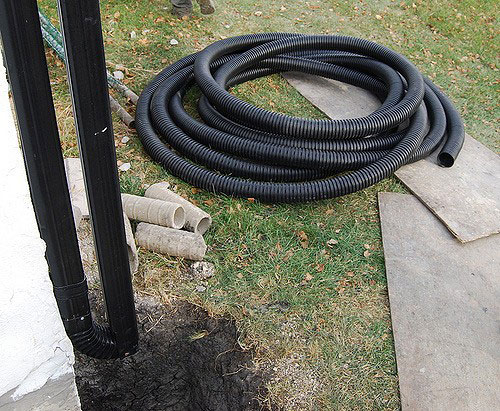
Downspouts work best when they do not have to work alone. Clean gutters reduce waterfalls. Correctly sized gutters reduce overflows at corners. Many older homes run 4 inch K-style eaves with 2 by 3 inch downspouts. Upgrading to 5 inch gutters with 3 by 3 or 3 by 4 downspouts can halve overflow events, which is often the difference between a dry and a damp wall. Leaf guards are a mixed bag here. On homes with maples and oaks, a simple perforated aluminum cover performs reliably, but the finer mesh screens clog with pollen and can create off-the-edge sheets of water in heavy rain if not maintained.
In winter, consider where ice forms. If you route a downspout across a walkway, you will build a skating rink every January thaw. In that case, routing underground to daylight in a shrub bed or to a bubbler outlet in the lawn is safer, provided the line is sloped and kept clear.
Grading, the quiet workhorse
Sod hides grading sins. Pull it back and you see the truth. My target is consistent, measurable slope for at least two metres from the foundation. On a typical London lot, that usually takes 1 to 3 cubic yards of soil to reshape the first few metres around the house. I use a compactible, low-organic fill for the bulk, then a 10 to 15 centimetre cap of screened topsoil for the sod bed. If you only add topsoil, the first big rain will settle it and steal your slope.
Edges matter. Air conditioning pads, paver borders, and concrete walkways often stand proud of the surrounding lawn, and they trap water. If a walkway hugs the house, I cut a narrow drain strip along the slab, fill it with 19 millimetre clear stone, and lay a perforated pipe socked in geotextile that slopes to daylight or a catch basin. It is not flashy, but it keeps water from backing toward the wall.
Between neighbours, swales are both a path and a peacekeeper. They should be shallow, continuous, and unblocked by fences or sheds. A good swale reads like a smile in cross section, with the low center guiding water along the property line and toward the front or rear catch point. If your swale is flat for eight metres, water will sit. Recutting a swale to maintain a 1 to 2 percent fall solves persistent disputes and is cheaper than any below-grade system.
When french drains make sense, and when they do not
The phrase french drains gets thrown around to cover any trench with a pipe in it. In a yard context, a true french drain is a perforated pipe wrapped in fabric and gravel that intercepts shallow groundwater or collects surface water that seeps into a gravel trench. It shines where you have a naturally wet seam across the yard or a low area you cannot regrade without breaking the lot drainage pattern.
In London’s clays, french drains work if you respect four rules. First, give water a reason to enter the trench, either by setting it at the low line or creating micro grading that nudges water toward the gravel. Second, provide a reliable outlet, ideally to daylight at the front or rear, or to a catch basin tied to a storm leader where permitted. Third, wrap the trench with non-woven geotextile before backfilling, or the clay fines will migrate into the clean stone and choke the system within a season. Fourth, maintain a steady slope in the pipe, even if it is only 1 percent. Flat equals stagnant, and stagnant equals freeze and clog.
What a french drain is not, at least here, is a band-aid for roof water at a downspout. Feeding a perforated pipe directly from a downspout usually dumps hundreds of litres into the upper soil profile right by the wall. You might as well point the spout at your basement. For roof water, use solid pipe until you reach the safe discharge point, then daylight to a bubbler, a pop-up emitter, or a stone splash zone.
If you search french drains London Ontario you will find plenty of installers, and the good ones will ask first about grading, not just sell you a trench. That is a sign they know the soil and the seasonality.
Weeping tiles and where they fit
Weeping tiles London Ontario typically refers to the foundation perimeter drain that sits at or near the footing, not a surface yard drain. Modern weeping tiles are perforated plastic pipe, often 100 millimetres in diameter, wrapped in gravel, with or without filter fabric. They collect groundwater and route it to a sump pit or a storm connection where available. If your basement takes water through wall-floor joints, or your sump runs constantly in spring, the perimeter system is the front line.
Replacing or adding weeping tile is an excavation job around the foundation, not a Saturday project. It is expensive, and it is the right solution when the problem is hydrostatic pressure at footing depth, not surface flow. I raise this because some homeowners try to solve a grading issue with a weeping tile job and spend five figures without fixing the source. If your dampness disappears when you extend downspouts three metres and restore slope, the perimeter drains were probably not the villain.
A practical sequence for most homes
Here is the order that has saved more basements and lawns in my projects than any single technology.
- Map roof water and extend every downspout two to three metres, testing temporary routes during a rain to see where the water naturally wants to go.
- Regrade the first two to three metres around the foundation to at least 2 percent fall, using compactible fill under a topsoil cap, and make sure hard surfaces do not trap water against the wall.
- Shape or recut swales along the side and rear lot lines to keep flow continuous to a safe outlet that respects your grading plan and neighbour boundaries.
- Only after the surface plan works, decide whether a solid-pipe downspout lead to a lawn bubbler or a catch basin will reduce nuisance icing or cross-traffic of water.
- If there are persistent wet seams in the yard unrelated to roof water, consider a french drain with proper fabric, stone, and a daylight outlet.
Each step informs the next. Many times, steps one through three resolve the trouble entirely. If not, steps four and five are targeted and cheaper now that the surface is under control.
Case notes from the field
Old South bungalow, 1950s build. The owner reported a musty smell in the basement and a wet line on the slab after every heavy rain. The back downspout on the driveway corner dumped onto a concrete pad that had sunk an inch against the foundation. The lawn pitched slightly toward the house. We clipped on a temporary three metre extension and ran it to the side swale. Next rain, the basement stayed dry. We then lifted and re-set the concrete pad with a controlled injection to pitch it away, added compactible fill along the wall, and capped it with 10 centimetres of topsoil for sod. Cost was a small fraction of any interior drainage system.
North London two-storey, newer subdivision. The backyard was a bowl shared by three lots. The client had installed a perforated pipe off a downspout into a gravel trench. Within a year it clogged, and water backed up and over the window well. We regraded the rear to establish a gentle diagonal fall to the west swale, ran solid 100 millimetre HDPE from the two rear downspouts to a pair of bubbler outlets in the lawn halfway to the swale, and added a small yard basin near the playset tied to the same solid line. Now, even in a 25 millimetre rain, water emerges at the bubble caps and moves to the swale without touching the foundation.
Byron split-level, mature trees and leaves. The gutters overflowed in autumn, flooding the flowerbeds, and ice formed on the side path. We upgraded to 5 inch gutters with larger downspouts, added basic aluminum leaf covers to keep out the bulk, and routed the troublesome side downspout underground in a solid pipe with a 1.5 percent slope to a pop-up emitter by the front shrub bed. The path stayed ice free. The owner now budgets a fall and spring gutter rinse to keep things honest.
Materials that stand up to clay, roots, and freeze
For buried lines off downspouts, I favour smooth-wall 100 millimetre HDPE or PVC solid pipe rather than corrugated. Smooth walls clear better and resist collapse. Corrugated is tempting because it bends around obstacles, but roots and silt find the grooves. If you must use corrugated, choose the heavy duty, not the thin black landscaping roll, and use long sweeps instead of sharp elbows.
A trench for a solid line does not need to be deep, but it must be consistent. I set a minimum 1 percent slope, closer to 2 if the yard allows, and lay the pipe on compacted sand or fine gravel. At the outlet, I like a green bubbler or pop-up emitter set in a flat area of lawn or a bed of 19 millimetre clear stone to reduce erosion. Where runoff crosses mulch or soil, a stone splash pad or small riprap dissipates energy.
For french drains, non-woven geotextile is non-negotiable. Wrap the trench like a burrito around the clean stone and pipe so that fines cannot invade. Use washed 19 millimetre angular stone, not pea gravel, which locks poorly. Depth depends on the target water, but in yards here the trench bottom is often 30 to 45 centimetres below grade. Again, slope is your ally.
Catch basins help when you have a flat patio or a low spot that cannot be regraded. Choose a basin with a debris bucket you can lift and clean. Tying basins together with solid pipe to an emitter keeps the system self-draining. Standing water in a basin is a mosquito nursery and a freeze hazard.
Where by-laws and utilities come into play
Before you dig, call for locates. In Ontario, the utility locate service is free and it catches more than gas and hydro. Cable and fiber lurk in shallow trenches along side yards, and clipping one will erase your savings quickly. If you are routing water toward the street, confirm you are not discharging onto the sidewalk or a neighbour’s property. The City of London has standards for lot grading on new builds, and while enforcement on retrofits is mostly complaint driven, the principles still apply. Do not connect sump pumps, weeping tiles, or roof drains to the sanitary sewer. If you have a storm lateral, ask a licensed contractor or the City whether it is active and permitted for connection. Rules vary by street and by era.
Costs you can expect, with room for the exceptions
Pricing moves with access, lengths, and finishes, but there are typical bands I see across London.
- Simple grading touch-ups along two sides of a house, including fill and sod patches, often run 1,200 to 3,000 CAD.
- Solid-pipe downspout extensions to bubbler outlets, two to four runs of 8 to 15 metres each, usually land between 1,500 and 4,500 CAD depending on obstacles and restoration.
- A yard french drain of 10 to 20 metres with fabric, stone, and a daylight outlet generally costs 3,000 to 7,500 CAD. Longer or deeper trenches, tight access, or lots of hardscape push higher.
- Catch basin additions with solid pipe to an emitter fall in the 1,200 to 3,500 CAD range per basin in a lawn setting.
Full perimeter weeping tile replacement is a different conversation entirely, often measured in tens of thousands, because it involves excavation, waterproofing, and restoration. I only suggest it when diagnostics truly point to a below-footing water problem.
How to vet drainage contractors in London, Ontario
London has capable firms that specialize in backyard drainage. The best of them start with grade and roof-water management rather than defaulting to expensive excavation. Ask to see a simple grading sketch as part of the estimate. Probe their choice of pipe and fabric. Smooth-wall solid for downspouts to a bubbler, perforated for true collection trenches, non-woven geotextile around stone, not just sock over the pipe. Listen for talk about outlets and slopes in percentages, not just in generalities.
You also want a contractor who can talk about restoration. Trench scars can undo curb appeal. A crew that cuts sod carefully, keeps topsoil segregated from clay fill, and repairs irrigation lines will leave your yard looking like it never happened. That attention shows up in the final invoice, but it also shows up in resale value.
Winter and spring realities
Snow complicates everything. Downspout extensions get kicked off, and ice dams form where sun and shade fight. If you rely on above-grade extensions, consider hinged or flexible units you can flip up for shoveling and flip down on warm days. Keep at least one safe discharge route open through the snowpack, even if that means cutting a shallow channel after a storm. In March, that channel can prevent a basement call.
Buried lines earn their keep in winter if they are self-draining. The key is slope and an outlet that does not sit in a sump of frozen ground. Pop-up emitters should return to closed when dry so debris does not blow in, but they must open easily under low head pressure from a gutter. If your emitter stays iced for weeks, move it to a sunnier or more sheltered location, or upsize the cap to reduce backpressure.
Landscaping with water in mind
Drainage improvements do not have to fight the garden. A well-placed shrub bed can become the landing zone for a bubbler. A dry creek of river stone across a shaded side yard can host the intermittent flows without turning to muck. Perennials tolerate the occasional surge better than lawn in tight corners. I group water-tough plants like Siberian iris or dogwoods near outlets where splashes happen, and keep mulch to a chunky shredded bark that stays put rather than fine mulches that float.
Permeable pavers are worth considering for walkways or small patios that sit in the path of flow. In London’s clay, permeable systems still need underdrains to move water out of the base, but they reduce surface runoff and slick ice. The trick is designing them as part of the broader drainage plan, not as an island that fills and freezes.
Maintenance that keeps systems alive
No drainage system is set-and-forget. Gutters and downspout strainers need cleaning at least twice a year, more if you have mature trees. Pop-up emitters and bubbler caps collect silt and grass clippings. Lift and rinse them every spring. French drains benefit from surface care too. Do not let the gravel strip silt over or the fabric will clog from the top down. If the drain runs under lawn, watch for subsidence and top up low spots so surface flow still finds the trench.
The best maintenance is vigilance. After a major storm, take ten minutes and walk the flow paths. Look for new ruts or pooling that hint at a grade shift. Check that fences, sheds, or play structures have not pinched a swale. Small corrections now are cheaper than reactive fixes later.
Edge cases and trade-offs
Some yards fight back. A rear lot lower than both neighbours may need a shared swale agreement or a small sump and pump to lift water to the approved outlet, especially if a municipal rear catch basin is missing. Pumps add moving parts and maintenance, so I treat them as a last resort and design for redundancy, including an alarm and a winter-safe discharge line.
Another common tangle is the finished patio set at or above the sill height of a rear door. If you cannot lower the patio, a trench drain along the house edge tied to a solid outlet is essential, and you may still need to add a mini curb or threshold to keep splash and snowmelt out.
Heavy shade slows evaporation, so even perfect grading can leave a lawn spongy. In those pockets, convert a few square metres to a planted bed with coarse mulch or stone, and route the nearest downspout away so that only ambient rainfall feeds the area.
Bringing it all together for backyard drainage London Ontario
When you approach backyard drainage London Ontario with a simple hierarchy, the rest falls into place. Put roof water where it belongs, away from the wall and toward a planned path. Shape the surface so gravity helps, not hinders. Only then add subsurface tools like french drains to solve specific, remaining problems. Along the way, remember the distinct roles. French drains collect infiltrating or seeping water along a line. Weeping tiles London Ontario protect foundations at footing depth. Solid downspout leads carry discrete pulses of roof water to a safe outlet.
If the project feels bigger than a weekend, that is normal. Grading and drainage are systems https://gunnerzxse235.almoheet-travel.com/the-home-seller-s-guide-to-weeping-tiles-in-london-ontario work, and two adjacent mistakes can cancel a bundle of good intentions. That is where experienced drainage contractors London Ontario earn their keep. They bring not only shovels and pipe, but judgment about slopes, soils, seasons, and the small adjustments that keep water moving where it should.
Do the fundamentals right, and you will feel it long before you see it. The basement smells like nothing at all. The lawn firms up two days after a storm. The side path stays clear in January. That is how you know the water is taking the path you chose for it.
Ashworth Drainage — Business Info (NAP)
Name: Ashworth DrainageAddress: 514 Hale St, London, ON N5W 1G8
Phone: (519) 660-9375
Website: https://www.ashworthdrainage.ca/
Email: [email protected]
Hours:
Monday: 9:00 AM – 5:00 PM
Tuesday: 9:00 AM – 5:00 PM
Wednesday: 9:00 AM – 5:00 PM
Thursday: 9:00 AM – 5:00 PM
Friday: 9:00 AM – 5:00 PM
Saturday: Closed
Sunday: Closed
Open-location code (Plus Code): XRR3+HV London, Ontario
Map/listing URL: https://maps.app.goo.gl/9kaoXAxRtJRP1ThS9
Embed iframe:
Socials (canonical https URLs):
Facebook: https://www.facebook.com/ashworthdrainage/
X: https://twitter.com/ashworthrules
Instagram: https://www.instagram.com/ashworthdrainage/
https://www.ashworthdrainage.ca/
Ashworth Drainage provides basement waterproofing and foundation repair services in London, Ontario and surrounding areas in Southwestern Ontario.
The company helps homeowners address wet basements, water intrusion, and drainage issues with solutions that fit the property’s conditions.
Service requests can include foundation repair, waterproofing options, sump pump and drainage-related work, and related assessments.
Ashworth Drainage is based at 514 Hale St, London, ON N5W 1G8.
To reach the team, call (519) 660-9375 or email [email protected].
Business hours are Monday to Friday 9:00 AM–5:00 PM, with the office closed Saturday and Sunday.
For directions and listing details, use the map listing: https://maps.app.goo.gl/9kaoXAxRtJRP1ThS9.
Popular Questions About Ashworth Drainage
What does basement waterproofing help prevent?Basement waterproofing is intended to reduce water intrusion and moisture problems that can lead to dampness, leaks, odors, and damage over time.
How do I know if I may need foundation repair?
Common signs can include visible cracks, water seepage, shifting or uneven areas, or recurring moisture problems; an on-site assessment is usually the best way to confirm causes and options.
What areas does Ashworth Drainage serve?
Ashworth Drainage serves London, Ontario and surrounding areas in Southwestern Ontario.
What are Ashworth Drainage’s hours?
Monday–Friday 9:00 AM–5:00 PM; Saturday closed; Sunday closed.
How can I contact Ashworth Drainage?
Phone: +1-519-660-9375
Email: [email protected]
Website: https://www.ashworthdrainage.ca/
Map: https://maps.app.goo.gl/9kaoXAxRtJRP1ThS9
Facebook: https://www.facebook.com/ashworthdrainage/
X: https://twitter.com/ashworthrules
Instagram: https://www.instagram.com/ashworthdrainage/
Landmarks Near London, ON
1) Kiwanis Park2) Western Fair District
3) Covent Garden Market
4) Victoria Park
5) Budweiser Gardens
6) Museum London
7) Fanshawe Conservation Area